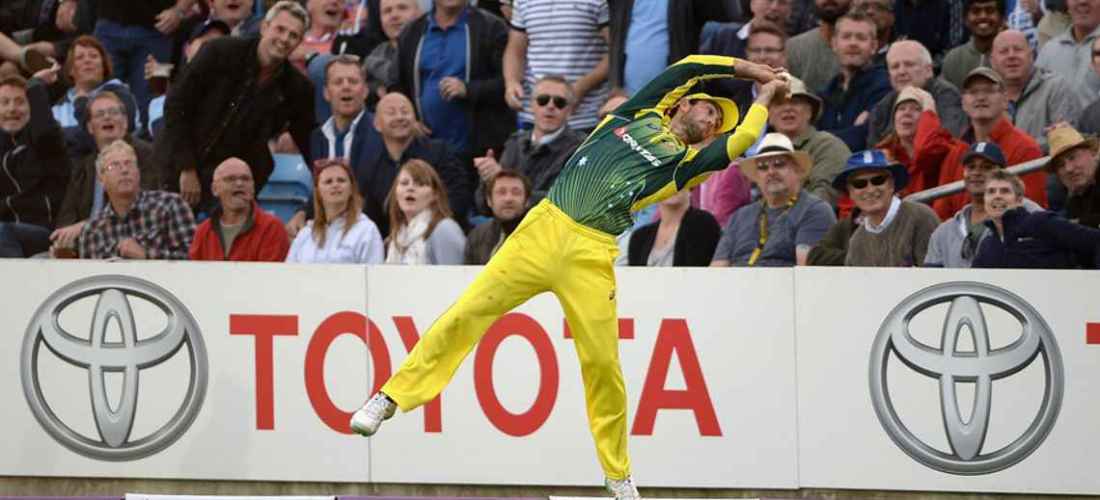
How many times have you heard it said of good fielders, “He’s worth 20 runs in the field”? This was a statement often used to describe former Australian all-rounder Andrew Symonds. The meaning behind the statement suggests that his untold value in the field made him worth far more to his team than the average player. A proper fielding metric could tell us how much.
It’s hard to believe then that after 141 years of playing cricket the most information you can uncover regarding fielding of yesteryear is the number of catches taken and, for wicketkeepers at least, the number of stumpings completed. Run-outs are not even measured and neither are catches by substitute fielders. These statistics are so primitive that they are commonly found under “batting and fielding” at the very end of the column.
If cricket only appreciated fielding as much as batting and bowling, then statistics on fielders would be measured in a far more detailed way. Fielding is consistently recognised as the sport’s third major discipline and yet, fielding statistics don’t get a section all to their own.
Fielding statistics just don’t exist. Certainly not in a real way. That’s a shame in many ways. It means that history will never be able to tell us the true impact of Symonds’ efforts or whether he was indeed a better fielder than the likes of Ricky Ponting, Jonty Rhodes, Mark Waugh, Bob Simpson, Mohammad Azharuddin, Geoff Marsh, Clive Lloyd, Brendon McCullum, David Boon, Garfield Sobers, George Bonnor and Neil Harvey.
Who took more catches? Who completed more run-outs? Who had better accuracy when they threw? Who fumbled more often? Cricket doesn’t know and, as a result, neither do we.
A large part of the early sabermetrics revolution in baseball showed that fielding was an overrated skill, whereas getting on base was an underrated skill. Generally speaking, baseball fielding has always been more athletic and of a higher quality than cricket fielding, yet weirdly, it might also be less important in the game.
Catching percentages are far lower in cricket however, the ball is fielded far more often in cricket than in baseball. This places greater emphasis on not making errors in the field which means that, unlike baseball, cricket analysts could yet prove that fielding is an undervalued skill.
A system which accurately and objectively assesses a fielder’s impact still eludes us after more than a century. Instead of finding itself an ingenious method of measuring fielding, the game falls back onto the one statistic that makes sense to even the casual observer. Runs.
A cricket clichè often used by commentators after a fielder makes a brilliant diving stop is, “he’s saved four runs there.” Did he? And if so, how many times does he “save four runs” per game?
Anyone who was viewing Channel Ten’s coverage of the 2017-18 Big Bash League would have seen Symonds himself using a plus/minus method in the commentary box to determine the number of runs saved and number of runs lost by each team in the field. This primitive system that Symonds developed relied on him simply taking notes on a sheet of paper of when athletic dives prevented runs being scored and when crucial mis-fields cost teams valuable runs to help him figure out where tight games were won or lost.
Sky Sports, in conjunction with CricViz, made use of a markedly similar system during the 2019 Cricket World Cup. As can be seen below, CricViz’s ‘runs saved’ statistics offers a measure of ground fielding both inside the inner ring (within 30 yards, or 27 metres, of the stumps) and in the outfield (i.e. patrolling the boundary).

This graphic was used by Sky Sports during the 2019 Cricket World Cup to show the number of runs each fielder has saved during the tournament // Sky Sports
This is not an objective measure like an average or strike rate, but it does allow the comparison of world class fielders and less than world class fielders that previously wasn’t possible. These statistics remain far from pristine, but should definitely be investigated further by statisticians. Players should be rewarded for making excellent diving saves, taking great catches and saving boundaries, but they should also be penalised for mis-fields and overthrows.
Another cliché commonly used states that “catches win matches”. Do they? Though it seems a no-brainer that this is the case, nobody is counting them well enough to check. This means that there is no accurate way to numerically measure whether catches indeed win matches. Or how much impact a spectacular one-handed diving catch has at a crucial stage of a given match?
The fact that runs are rated more highly than catches, or any other kind of fielding dismissal for that matter, has led to an increase in the number of wicketkeeper batsmen compared to that of specialist wicketkeepers, especially in the shortest form of the game. A ‘keeper who can bat a bit is rated higher than one concentrates on keeping wicket alone.
Using the traditional batting average to evaluate a batsman’s value in Twenty20 cricket, let’s assume that a decent No. 4 batsman averages 30 runs a game. If you were a selector and had two options, a player who makes 31 runs a game and another who makes 27. Who would you select?
Proper fielding data could show that the player averaging less runs might also bring you two run-outs and four catches more across the season in addition to actively saving extra runs in the field. Suddenly the conversation is taken from “He’s probably worth 20 runs in the field” to “He’s worth 8.3 runs and .35 more dismissals a game in the field than the other player.”
The ability of a fielder to dismiss a batsman is a key responsibility for the fielder however, any good fielder must also be able to aid his team’s bowlers in the prevention of run-scoring. This is the secondary role of the 11 players on the fielding team and an increasingly critical component of Twenty20 cricket.
Despite all efforts to quantify the number of runs an individual fielder can prevent opposition batsmen scoring, it seems that some element of subjectivity will always remain. Symonds’ system, for example, depends on him eye-balling every delivery, and crediting and debiting fielders for their actions as he sees fit.
It can be assumed that this is also true in the case of that Sky Sports graphic. Someone, somewhere (perhaps aided by another person) must be doing backbreaking work behind the scenes, tapping a plus or minus button on an iPad to record the number of runs saved or lost by each fielder.
As a result of this, any ‘runs saved’ statistic will be, without exception, a record of what an observer thinks should have been accomplished. It merely stands as a moral and subjective judgment. The fact remains that no play has been made but that the scorer thinks it should have. It is a record of opinions.
A talent for avoiding obvious failure is no great trait in a professional player. The easiest way to not make a mistake is to be too slow to reach the ball in the first place. As the father of sabermetrics, Bill James, wrote in his 1977 Baseball Abstract, “you have to do something right to get an error; even if the ball is hit right at you, then you were standing in the right place to begin with.”
Perhaps this explains why pioneering cricket statisticians gave up on it long ago under the belief that it was too technical and finicky. Nevertheless, we persist. By establishing new and funky ways of evaluating the impact of fielding in cricket, we can place objective values on players rather than provide subjective opinions over whether a fielder catches better, throws harder or runs faster. Hopefully some day meaningful fielding statistics will help re-invent the way cricket’s third major discipline is viewed. Until then, we can only try.
 Viper Cricket Statistics